
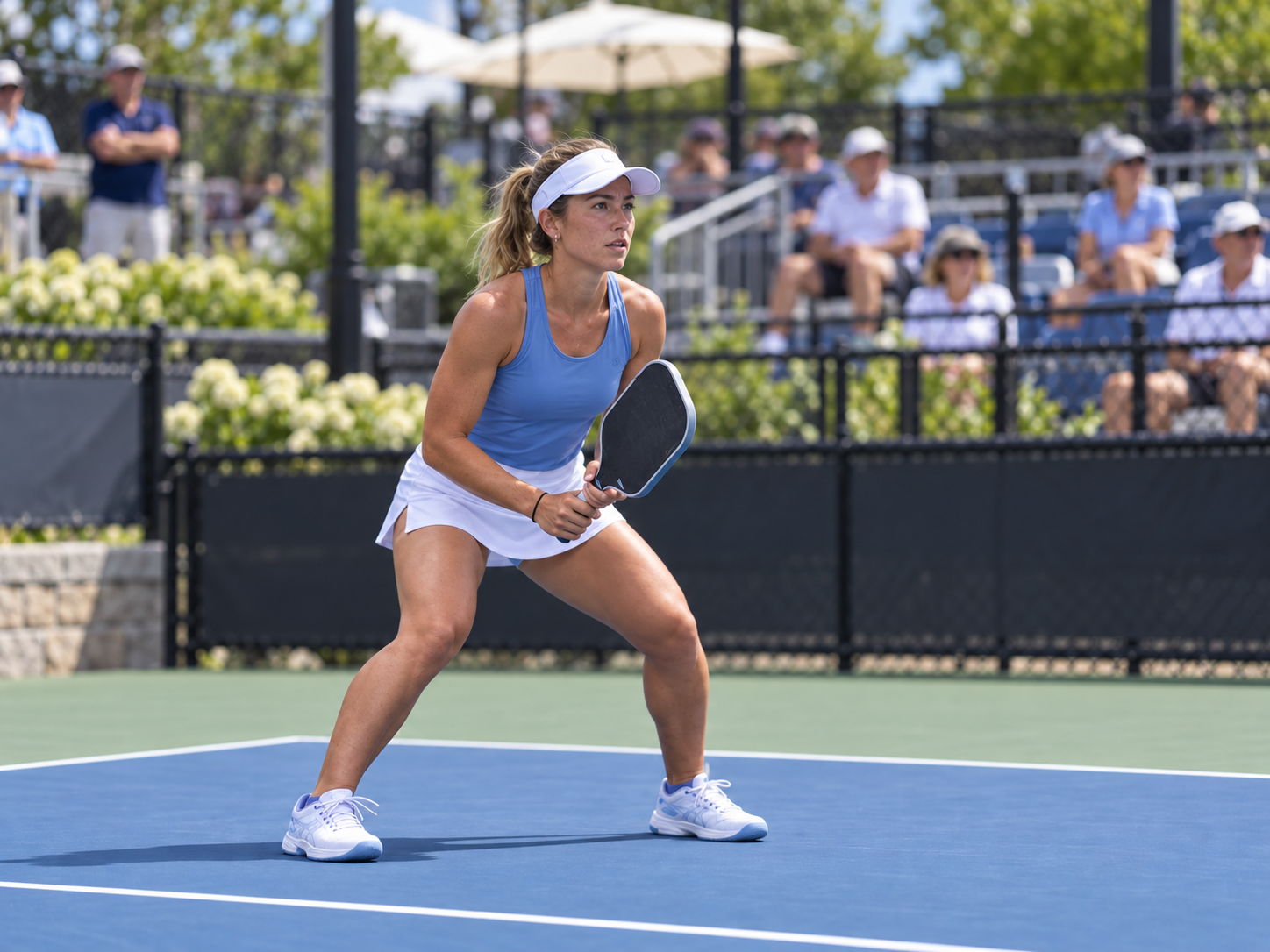
Good pickleball movement begins before the ball comes toward you. If you wait until you know exactly where the ball is going before preparing your body, you may already be late.
The pickleball ready position gives you a balanced starting posture from which you can react in different directions. Instead of standing upright or resting between shots, you stay prepared to move, adjust your paddle, and respond to the next ball.
A good ready position is not rigid or uncomfortable. Your feet provide a stable base, your knees are slightly bent, your upper body remains relaxed, and your paddle stays in front of you. The goal is to be prepared without creating unnecessary tension.
Why the Pickleball Ready Position Matters
During a rally, the ball can change direction quickly. You may need to move left, right, forward, or backward depending on the opponent’s shot.
Your starting posture affects how easily you can make those movements.
When you stand upright with straight legs and your weight settled heavily on your heels, starting a movement takes extra time. You first have to lower your body and shift your weight before you can move efficiently.
The pickleball ready position removes much of that delay. Your body is already balanced and prepared to react.
Think of it as a neutral starting point. You are not committing yourself to one direction. Instead, you are putting your body in a position that allows several possible movements.
This position also helps with paddle preparation. Keeping the paddle in front of your body reduces the amount of unnecessary movement required when the ball arrives.
Building a Balanced Athletic Stance
A useful athletic stance begins with your feet approximately shoulder-width apart.
This does not need to be measured precisely. You simply want enough space between your feet to create a stable base without spreading them so far apart that movement becomes difficult.
Your weight should feel balanced between your left and right sides. Avoid leaning heavily toward one foot unless you are actually beginning a movement.
From this position, bend your knees slightly.
The knee bend should be comfortable. You are preparing to move, not performing a deep squat. Bending too deeply can create unnecessary tension and make it harder to move naturally.
Your hips will lower slightly as your knees bend. Keep your upper body relaxed and allow a small forward posture rather than standing completely vertical.
Imagine that you are prepared to move but could comfortably remain in the position for several moments. If your legs begin working excessively just to hold the stance, you are probably crouching too low.
A practical beginner stance combines stability with freedom of movement.
Keep Your Weight Balanced and Ready to Move
Balance is one of the main purposes of an athletic stance.
You should not feel as though your body is falling forward, backward, or toward either side. Your position should allow you to initiate movement without first correcting your balance.
Keep your weight toward the front portion of your feet rather than settling heavily onto your heels. This is often described as staying on the balls of your feet.
That does not mean standing on your toes with your heels lifted high off the court. Your feet can remain naturally connected to the ground. The idea is simply to avoid becoming flat-footed and heavy.
A useful self-check is to ask yourself whether you could immediately take a small step in any direction.
Could you move left without first shifting your body?
Could you move right?
Could you step forward?
If you have to make a large weight shift before taking the first step, adjust your stance until your body feels more centered and responsive.
Avoid an Overly Deep Stance
Beginners sometimes hear “bend your knees” and respond by dropping into a very low position.
That is unnecessary.
A deep squat may look athletic, but it can make movement tiring and uncomfortable. It may also cause you to become tense rather than responsive.
Use only enough knee bend to keep your legs active and your body prepared to move.
Your stance should also change naturally depending on the situation. You do not need to maintain exactly the same knee angle throughout an entire rally.
The key is to avoid the two extremes: standing completely upright with locked or nearly straight legs, and crouching so deeply that movement becomes difficult.
The best position is somewhere between those extremes—a relaxed athletic posture that gives you balance and mobility.
Keep Your Upper Body Relaxed
The lower body creates your base, but your upper body should remain relatively relaxed.
Avoid raising your shoulders toward your ears or tightening your arms unnecessarily. Excessive tension can make paddle movement slower and less controlled.
Your torso should have a slight forward posture while remaining balanced. Avoid bending dramatically at the waist. You want to look and feel alert, not folded forward.
Keep your head up.
Looking down at the court can interfere with your ability to follow what is happening in front of you. Your eyes need to track the ball while also picking up useful information from your opponent.
A good athletic stance allows you to see the play clearly without changing your posture every time the ball moves.
Watch the Ball and Your Opponent
Being physically ready is only useful when you are also paying attention.
Keep your head up and track the ball throughout the rally. At the same time, maintain awareness of the opponent who is preparing to hit.
Watching the opponent can help you recognize what is developing before the ball reaches your side of the court.
You do not need to guess where every shot will go. The purpose is simply to remain visually engaged rather than relaxing or looking away after you have hit your own shot.
One common beginner habit is to admire a shot after making contact. The player watches the ball travel toward the opponent but forgets to prepare for what happens next.
Instead, use the time after your shot to recover your balance, bring your paddle back into position, and prepare for the opponent’s response.
Keep the Paddle in Front
Your paddle is part of your ready position.
After hitting a shot, bring the paddle back in front of your body rather than leaving it hanging at your side or behind you.
A neutral paddle position keeps your paddle available for either side of the body. You should be able to move it toward a forehand or backhand response without making an unnecessarily large motion first.
Keep the paddle at a comfortable height in front of you. Avoid letting the paddle head hang near your knees between shots.
There is no need to hold it extremely high either. A neutral position around the front of your torso gives beginners a practical starting point.
Your elbows and shoulders should remain relaxed. Holding the paddle ready does not mean gripping it tightly or locking your arms into place.
Think of the paddle as being available rather than fixed.
Prepare to Move in Any Direction
A good pickleball ready position does not predict the next shot. It prepares you for several possibilities.
Your balanced feet and slight knee bend allow you to begin moving toward either side. Your forward posture helps you respond when you need to move toward the ball. Your centered balance also makes it easier to adjust when the ball forces you away from your original position.
This is why leaning too strongly in one direction can cause problems.
For example, if you assume the next ball will come to your forehand and shift your weight early, a ball sent toward your backhand may force you to reverse that movement before you can respond.
Remaining balanced gives you more options.
Preparation and movement are therefore two different things. The ready position prepares you to move. Once you recognize where the ball is going, you leave that neutral position and move toward the appropriate location.
Return to Ready Position After Each Shot
Your ready position is not something you establish once at the beginning of a rally.
You repeatedly return to it.
A simple pattern is:
- Begin in a balanced ready position.
- Move toward the incoming ball.
- Make your shot while maintaining control.
- Recover your balance and useful court position.
- Bring the paddle back in front.
- Prepare for the next shot.
This cycle may happen several times during a single rally.
Beginners often complete the first few steps but forget the recovery. They hit the ball and remain in the finishing position of the previous shot.
That creates a problem because the opponent is already preparing to send the ball back.
Treat every shot as having a beginning and an end. The shot is not truly finished when the ball leaves your paddle. Your preparation for the next ball begins immediately afterward.
Adjust Your Ready Position Around the Court
The basic principles of the ready position remain useful throughout the court, but the exact posture does not have to remain identical everywhere.
Deeper in the court, you may have more time to react to an incoming ball. Your stance can remain balanced and athletic without becoming excessively low or tense.
Closer to the net, the available reaction time can become shorter. Keeping the paddle in front and maintaining an alert, balanced posture becomes especially important.
The essential ideas remain the same: balanced feet, slightly bent knees, relaxed upper body, head up, paddle ready, and body prepared to move.
Avoid trying to memorize one exact pose. Learn the principles instead, then allow your position to adjust naturally according to where you are on the court and what is happening in the rally.
Common Ready-Position Mistakes
One common mistake is standing too upright. Straight legs and an upright posture make it harder to begin moving quickly. A slight knee bend and athletic posture create a better starting position.
Another mistake is becoming flat-footed. When your weight settles heavily onto your heels, the first movement can feel slow. Keep your weight balanced and your feet active.
Some beginners go too far in the opposite direction and crouch extremely low. An overly deep stance wastes energy and can make movement awkward. Use a comfortable knee bend rather than a squat.
Letting the paddle drop is another frequent problem. If the paddle hangs at your side after every shot, you have to bring it back into position before responding. Returning it to the front of your body removes that unnecessary step.
Excessive tension also causes problems. Tight shoulders, rigid arms, and a stiff posture do not make you more prepared. They can restrict movement. Stay alert while keeping the upper body relaxed.
Finally, avoid watching your previous shot for too long. Once the ball travels toward your opponent, your attention should shift toward preparing for the return.
A Simple Ready-Position Practice Drill
You can practice the pickleball ready position without hitting a ball.
Start by standing comfortably with your feet approximately shoulder-width apart. Bend your knees slightly and establish balanced weight over your feet.
Check your upper body. Keep it relaxed with a slight forward posture.
Raise your head and look ahead as though an opponent were across the net.
Bring the paddle in front of your body at a comfortable neutral height.
Hold this position briefly and notice how your body feels. You should feel stable without feeling stuck.
Next, relax and stand normally. Then rebuild the ready position.
Repeat the process several times. Each repetition should become simpler: feet balanced, knees slightly bent, body relaxed, head up, paddle in front.
Once the position feels familiar, add small movements. From your ready stance, take a controlled step to the left and return to balance. Then move to the right and return. Add a small forward movement and recover again.
The purpose is not speed. You are practicing the relationship between preparation, movement, and recovery.
After every movement, return to the same balanced starting posture.
This helps develop an important habit: move, recover, and get ready again.
Use the Ready Position as Your Reset
Pickleball becomes easier to manage when you have a dependable position to return to between movements.
You will not remain perfectly still in one athletic stance throughout a rally. You will move, turn, reach, hit, and recover. The ready position gives you a reliable reset point after those actions.
When you are unsure what your body should be doing between shots, check the basics.
Are your feet balanced?
Are your knees slightly bent?
Is your weight ready to move rather than settled heavily on your heels?
Is your upper body relaxed?
Is your head up?
Is your paddle in front?
Those simple checks can correct many beginner preparation problems before they turn into missed shots.
Key Takeaways
- The pickleball ready position is a balanced starting posture that prepares you to react and move in different directions.
- Keep your feet approximately shoulder-width apart, your weight balanced, and your knees slightly bent without dropping into a deep squat.
- Maintain a relaxed upper body with a slight forward posture, keep your head up, and watch the ball and your opponent.
- Keep the paddle in front of your body at a comfortable neutral height so it is ready for the next shot.
- Avoid becoming flat-footed. Keep your weight responsive and your feet prepared to move.
- After every shot, recover your balance, return the paddle to the front, and reestablish your ready position.
- Practice moving out of the ready position and returning to it. The goal is a simple repeatable habit: prepare, move, recover, and prepare again.