
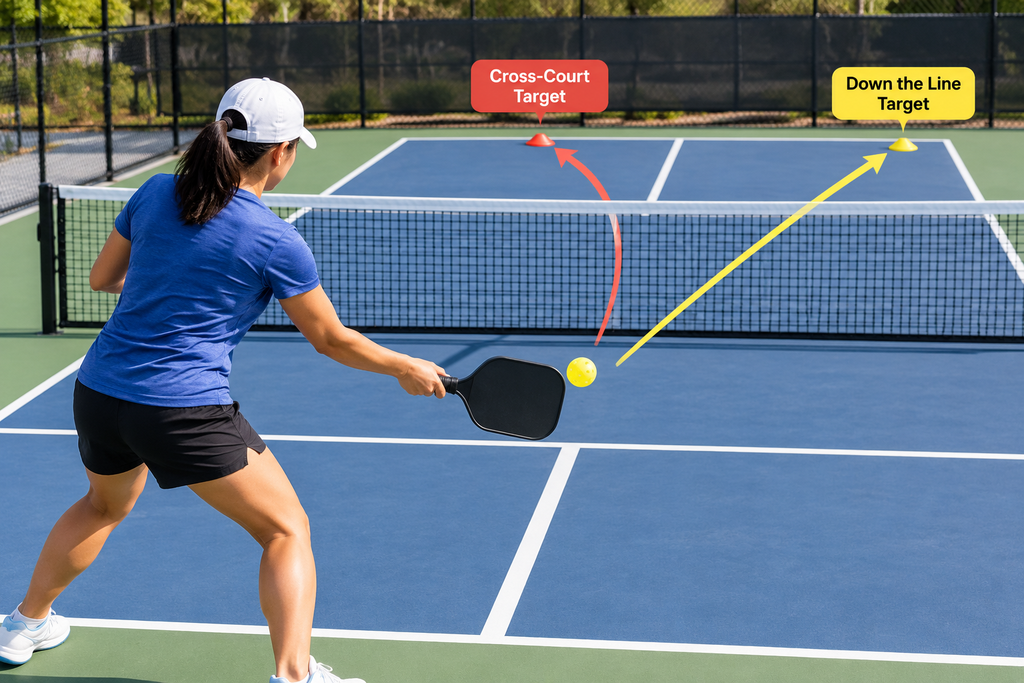
Controlling Shot Direction
Hitting the ball over the net is an important first step, but as your groundstrokes become more reliable, the next skill is deciding where you want the ball to go. Instead of simply reacting and sending the ball back, you can begin choosing a target before you swing.
Good pickleball shot placement does not require hitting close to the lines or creating difficult angles. For beginners, directional control starts with large, safe target areas and a repeatable swing. Your body position, paddle face, contact point, and follow-through all influence where the ball travels.
The goal is simple: choose a reasonable target, make a controlled swing, and give yourself enough margin to keep the ball in play.
Contact And Placement Are Different Skills
Making clean contact and controlling placement are related, but they are not the same thing.
When you are first developing a forehand or backhand, much of your attention goes toward reaching the ball, making contact in front of your body, and sending it safely over the net. Once those actions become more comfortable, you can start paying more attention to direction.
Placement means deliberately sending the ball toward a chosen part of the court. You might aim cross-court, down the line, or toward the middle.
You do not need perfect accuracy. If you choose a large target area and the ball lands somewhere within that general area, the shot has accomplished its purpose.
Think in terms of zones rather than exact spots. Trying to hit a tiny spot creates unnecessary pressure and leaves little margin for normal variation in your swing.
Choose Your Target Before You Hit
Directional control begins before the paddle touches the ball.
As the ball approaches, decide where you want to send it. Making this decision early allows you to position your body and prepare your paddle for the intended direction.
A beginner-friendly routine is:
- Watch the approaching ball.
- Move into a balanced hitting position.
- Choose a large target area.
- Prepare the paddle.
- Make clean contact.
- Follow through toward the target.
The target should usually be an area rather than a line or corner. For example, you might aim toward the middle third of the opponent’s court rather than trying to place the ball a few inches inside the sideline.
Choosing your target early also reduces last-second corrections. When players decide where to hit during the swing, they often twist the wrist, change the paddle angle, or rush the contact. Those adjustments make directional control much less reliable.
Use Large Target Areas
Large targets are one of the simplest ways to improve pickleball shot placement.
Imagine dividing the opponent’s court into broad areas. You could choose the left side, middle, or right side. These areas give you a clear purpose without demanding precision that your current technique may not consistently produce.
Large targets also give you room for error. A shot does not have to land exactly where you intended to be useful.
Suppose you aim toward the middle of the court. If your ball travels a little left or right, it may still land comfortably inside the boundaries. If you aim directly at a sideline and miss by the same amount, the ball may land out.
That extra margin matters.
Directional control should make your shots more dependable, not make them harder to keep in play.
Directing The Ball Cross-Court
A cross-court shot travels diagonally across the court. If you are hitting from one side, the ball travels toward the opposite side of your opponent’s court.
For example, if you are positioned toward the right side of your court, a cross-court groundstroke would travel diagonally toward the opponent’s right side from their perspective.
Cross-court shots provide a large area to work with and are useful for practicing directional control.
Start by choosing a broad cross-court target. Position yourself comfortably, make clean contact, and allow your paddle to travel naturally toward that area.
Avoid trying to create an extreme angle. The purpose of beginner cross-court practice is to learn how your preparation and paddle direction influence the ball.
If you can repeatedly send the ball into a broad diagonal area, you are developing useful directional control.
Directing The Ball Down The Line
A down-the-line shot travels more directly along the side of the court rather than diagonally across it.
This direction requires good control because the sideline is nearby. Beginners sometimes hear “down the line” and assume they should aim directly at the line. That creates unnecessary risk.
Instead, aim several feet inside the boundary.
You can still send the ball in a down-the-line direction while maintaining a comfortable safety margin. The direction matters more than hitting close to the sideline.
Use the same controlled groundstroke mechanics you normally use. Avoid swinging harder simply because you are changing direction.
A controlled ball several feet inside the line is generally a better practice result than a more impressive shot that frequently lands outside the court.
Hitting Toward The Middle
The middle of the court is another useful target for beginners.
Aiming toward the middle gives you generous space away from the sidelines. This makes it easier to practice placement while keeping more balls in play.
Middle targets are especially helpful when you are still learning to control your paddle face. Small errors in direction are less likely to send the ball out.
During practice, place a cone or flat marker well inside the opponent’s court and use the surrounding area as your target. Do not worry about striking the marker. The marker simply gives your eyes and body a clear reference.
The objective is to develop the connection between seeing a target and directing your shot toward it.
How Body Alignment Influences Direction
Your body position affects the direction of your swing.
When you move into position for a groundstroke, give yourself enough space to swing comfortably. If the ball gets too close to your body, you may be forced to change your paddle path. If it is too far away, you may reach and lose balance.
Neither situation is ideal for directional control.
Your feet and body should support the shot rather than fight against it. Move into position first, establish balance, and then swing.
You do not need to dramatically turn your entire body toward every target. Instead, make small positioning adjustments that allow the paddle to travel naturally in the intended direction.
Trying to redirect the ball while your body is badly positioned often leads to a late wrist adjustment. Good footwork makes aiming easier because it gives you a comfortable contact point and a more predictable swing.
Control The Paddle Face
The paddle face is the flat surface of the paddle that contacts the ball. Its direction at contact has a major influence on where the ball travels.
If the paddle face points farther to one side than you intended, the ball is likely to travel in that direction. Even a small unintended change can affect placement.
This is why a stable paddle face is important.
You do not need to steer the ball with complicated hand movements. Prepare the paddle, establish the intended direction, and make a smooth swing.
Avoid flicking or turning your wrist at the last moment to change direction. That makes the paddle face harder to control and introduces another variable into the shot.
A simpler motion is easier to repeat.
Understand The Role Of Contact Point
Where you meet the ball also affects your ability to control direction.
For basic groundstrokes, you generally want to make contact comfortably in front of your body. This gives you room to swing through the ball and maintain a stable paddle face.
If contact happens too late, the ball may travel in an unintended direction. You may also feel rushed and attempt to compensate with your wrist.
If you reach too far in front, you can lose balance and control.
Good footwork helps solve both problems. Rather than reaching for the ball, move your feet so that you can contact it from a comfortable position.
Consistent contact makes directional control more predictable. When the ball meets the paddle in roughly the same comfortable area from one shot to the next, it becomes easier to understand how your swing affects placement.
Follow Through Toward The Target
Your follow-through should support the direction you selected.
After contact, allow the paddle to continue naturally toward the intended target area. You do not need to force the paddle into an exaggerated position. Think of the follow-through as a continuation of your swing rather than a separate movement.
If you are aiming cross-court, your swing path should support that direction. If you are aiming more directly down the line, the paddle should continue more toward that area.
A smooth follow-through also helps prevent abrupt changes immediately after contact.
One useful practice cue is “finish toward the target.”
It is simple enough to remember while allowing you to concentrate on balance and clean contact.
Maintain Balance While Aiming
Directional control becomes much harder when you are off balance.
Beginners sometimes become so focused on the target that they forget the fundamentals of the stroke. They lean toward the target, reach with the paddle, or swing harder in an attempt to force the ball into a particular area.
Keep your normal balanced stance.
Move your feet before swinging whenever possible. Create comfortable space around the ball. Make contact in front, and finish the stroke without falling or stumbling toward the target.
Your swing speed should also remain comfortable and consistent.
You do not need extra speed to change direction. In fact, hitting harder gives you less margin for error because small mistakes in paddle angle can send the ball farther from your intended target.
Control the direction first. Pace can remain comfortable.
Use The Same Principles On Forehands And Backhands
Directional control applies to both forehand and backhand groundstrokes.
On the forehand side, prepare early, move into position, establish a comfortable contact point, and guide the swing toward your selected area.
On the backhand side, use the same basic approach. Prepare early, create enough space for the stroke, keep the paddle face controlled, and follow through toward the target.
You may initially find one side easier than the other. That is normal from a skill-development standpoint, but both sides should be practiced.
Do not compensate for a less comfortable side by swinging harder. Use a large target and concentrate on clean contact.
The purpose is to build predictable control on both sides of your body.
Change Direction Without Overhitting
Changing the direction of the ball can feel more difficult than returning it in a natural direction. A common reaction is to swing harder when trying to redirect the shot.
More power does not automatically produce better placement.
Use a comfortable swing speed and focus on your preparation, paddle face, contact point, and follow-through.
If the shot repeatedly misses the target, reduce the difficulty rather than increasing your effort. Choose a larger target, take some pace off the ball, and give yourself more margin.
Once you can repeatedly direct the ball into a large area, you can gradually make the target smaller.
Give Yourself Margin From The Lines And Net
Good pickleball shot placement includes knowing where not to aim.
The sidelines and baseline define the court, but they do not need to become your targets. Aiming very close to a boundary leaves little room for error.
Instead, create a safety margin inside the court.
The same principle applies to the net. Trying to send every groundstroke barely above the net creates unnecessary risk. Give the ball enough height to clear the net comfortably while still keeping it inside the court.
Think of your safest target as an area surrounded by space. The farther the target is from a boundary, the more room you have for a slightly imperfect shot.
For beginners, consistency is more valuable than hitting difficult targets.
Practice With Simple Target Drills
Target practice helps you connect technique with intention. Cones, flat markers, or other safe court markers can give you a clear visual reference.
Begin with two large target areas on the opposite side of the court. One might represent a cross-court target and the other a down-the-line target. Keep both targets comfortably inside the boundaries.
Hit several controlled shots toward one area before switching to the other. This gives you time to recognize how your positioning, paddle face, and swing direction affect the ball.
Next, alternate targets. Hit one shot cross-court, then one toward the middle, then one down the line. Keep your swing speed comfortable.
Track how many balls land in the intended general area. You are measuring controlled placement, not perfection.
For example, if you hit ten forehands toward a large cross-court zone and seven land in or near that area, you have a useful starting point. Repeat the drill and look for greater consistency rather than trying to hit harder.
You can perform the same drill with backhands.
If accuracy begins to decline, check the fundamentals. Are you moving into position? Are you balanced? Is your contact point consistent? Is your paddle face stable? Are you making a sudden wrist adjustment?
Correct one problem at a time.
Common Beginner Aiming Mistakes
One common mistake is choosing the target too late. When you make the decision during the swing, you may attempt to steer the ball at the last second.
Choose the target earlier.
Another mistake is aiming too close to the sidelines. A target can still be useful without being near a line. Move the target farther inside the court and give yourself more margin.
Beginners may also change their entire stroke when aiming in a different direction. Your basic forehand or backhand should remain recognizable. Direction should come from controlled preparation, alignment, paddle face, contact, and follow-through rather than a completely different swing.
Overhitting is another frequent problem. If you can direct a controlled shot accurately at moderate pace, you are developing a stronger foundation than if you occasionally hit a fast ball into a difficult target.
Finally, avoid watching the target so intently that you stop watching the approaching ball. Select your target early, then give the ball the attention needed for clean contact.
Build Control Before Precision
Directional control develops gradually.
Start with large targets well inside the court. Practice sending forehands and backhands toward the middle, cross-court, and down the line. Maintain a comfortable swing speed and generous margins around the boundaries.
As your placement becomes more dependable, you can gradually reduce the size of your target areas.
The important change is not whether you can hit a tiny spot. It is whether your shots increasingly go where you intend them to go.
When you can choose a target before the shot and repeatedly send the ball toward that general area while staying balanced, you are no longer simply returning the ball. You are beginning to control it.
Key Takeaways
- Choose your target before you swing. Early decisions make it easier to position your body and paddle correctly.
- Aim at large, safe areas. Cross-court, down-the-line, and middle targets can all be practiced without aiming close to the boundaries.
- Use your fundamentals to control direction. Body alignment, paddle face, contact point, and follow-through all influence where the ball travels.
- Stay balanced and avoid last-second wrist changes. A controlled, repeatable swing produces more dependable placement.
- Give yourself margin. Leave space from the sidelines and enough height above the net to reduce unnecessary errors.
- Practice both forehand and backhand placement. Use cones or markers, alternate target areas, and track successful placements.
- Build control before precision. Consistent shots into large target areas provide the foundation for more intentional pickleball play.