
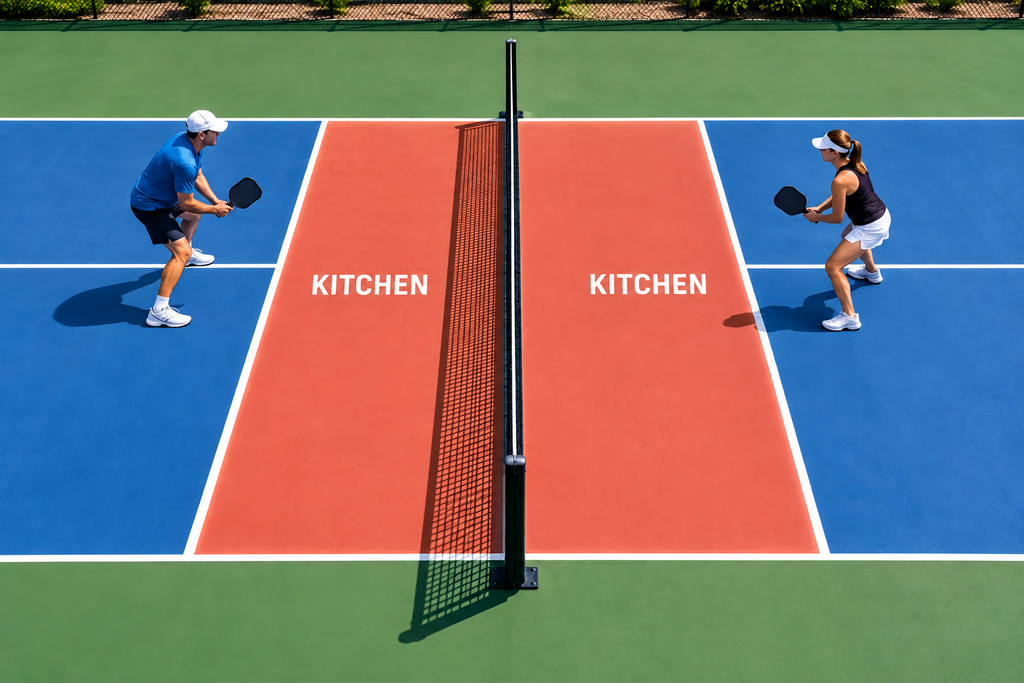
Understanding the Kitchen
The pickleball kitchen is one of the most distinctive parts of a pickleball court. It affects how players approach the net, where they position themselves, and what they can do when the ball is in the air.
For beginners, the kitchen can seem confusing because its name does not describe what it actually is. The official name is the non-volley zone, often shortened to NVZ. It is the area immediately next to the net on both sides of the court.
Understanding this area starts with one important idea: the kitchen is not a place where you are forbidden to stand. Instead, it is an area where certain restrictions apply when you hit a volley.
Once you understand the location and purpose of the kitchen, many situations near the net become much easier to recognize.
What Is the Pickleball Kitchen?
The pickleball kitchen is the non-volley zone extending 7 feet from the net on each side of the court. It stretches across the full width of the court.
Because there is a non-volley zone on both sides of the net, the two kitchen areas create a 14-foot-wide space separating players when they are positioned immediately outside their respective kitchen lines.
The line marking the back edge of the kitchen is commonly called the kitchen line or non-volley zone line.
The kitchen line is considered part of the non-volley zone. This distinction matters because touching the line means you are touching the kitchen.
When looking at a pickleball court, imagine three major areas running from one baseline to the other. There is a service-court area on one side, the kitchens surrounding the net in the middle, and another service-court area on the opposite side.
This makes the kitchen easy to locate: find the net, and the rectangular area extending 7 feet away from it on either side is the non-volley zone.
Why Is It Called the Kitchen?
The official rules use the term non-volley zone, but players almost universally refer to it as the kitchen.
The nickname can be confusing because it does not describe the area’s function. For learning purposes, it is more useful to focus on the official term.
The words non-volley zone tell you exactly why the area exists.
A volley occurs when you strike the ball out of the air before it bounces. The kitchen limits where players can perform this type of shot.
This restriction prevents players from standing immediately beside the net and repeatedly hitting balls out of the air from an extremely close position.
That changes the character of pickleball significantly.
Instead of allowing players to crowd the net and dominate every airborne ball from close range, the non-volley zone creates distance between a player making a volley and the net.
Understanding the Kitchen Lines
The kitchen is defined by court lines, so recognizing those lines is an important part of understanding where you are during play.
The non-volley zone line runs parallel to the net, 7 feet away from it. Everything between that line and the net is part of the kitchen.
The line itself is also part of the kitchen.
That means the kitchen does not begin immediately beyond the line toward the net. It includes the line.
This is useful to remember whenever you position yourself near the non-volley zone. If your shoe is touching the kitchen line, you are touching the kitchen.
The sidelines also form the outer boundaries of the non-volley zone. Together, the net, sidelines, and non-volley zone line make the kitchen easy to identify visually.
As a beginner, make a habit of noticing the kitchen line whenever you approach the net. Court awareness becomes easier when you know where the line is without needing to look down constantly.
The Kitchen and the Service Courts
The kitchen should not be confused with the service courts.
Behind the kitchen line, the centerline divides the remaining area between the kitchen and baseline into the left service court and right service court.
The kitchen itself is not divided into left and right service boxes in the same way.
This distinction becomes especially noticeable when looking at the court from above. The centerline ends at the non-volley zone line rather than continuing through the kitchen to the net.
The result is one rectangular non-volley zone stretching across the width of each side of the court.
Knowing the difference between the kitchen and the service courts makes it easier to understand court positioning. The service courts occupy the deeper portion of each side, while the kitchen occupies the area closest to the net.
What Is a Volley?
To understand the purpose of the pickleball kitchen, you need a clear understanding of a volley.
A volley is a shot you hit before the ball bounces on your side of the court.
Imagine an opponent sends the ball toward you. If you strike it while it is still in the air, you have hit a volley.
If you allow the same ball to bounce before hitting it, the shot is no longer a volley. You are playing the ball after a bounce.
That difference is central to understanding the non-volley zone.
The kitchen’s restrictions are connected specifically to volleying. This is why simply thinking, “I can never go into the kitchen,” gives beginners the wrong idea.
The more useful question is: Did the ball bounce, or am I hitting it out of the air?
That distinction helps explain what the kitchen is designed to control.
Being in the Kitchen Is Not Automatically a Fault
One of the most common beginner misconceptions is that players are never allowed to enter the kitchen.
You can enter the kitchen during a rally.
For example, suppose your opponent sends a short ball that bounces inside your kitchen. You may step into the non-volley zone and play that ball after the bounce.
The important distinction is that you are not volleying it.
This is why the official name is so helpful. It is the non-volley zone, not a “no-entry zone.”
Consider two situations.
In the first, the ball bounces inside the kitchen. You step forward and hit it after the bounce. Being inside the kitchen does not, by itself, prevent you from playing that ball.
In the second, the ball is still airborne and you attempt to strike it before it bounces. Now the non-volley zone becomes directly relevant because you are attempting a volley.
Recognizing the difference between these situations removes much of the confusion beginners experience around the kitchen.
Why Does the Kitchen Exist?
Without the non-volley zone, players could position themselves extremely close to the net and hit airborne balls downward from a powerful position.
That would make it much more difficult for opponents to respond and would dramatically change play near the net.
The kitchen creates space.
When players want to volley, they must respect the non-volley zone rather than moving directly against the net. This creates more opportunities for controlled exchanges and makes positioning near the net more important.
The kitchen also helps produce one of pickleball’s defining characteristics: close-range play that depends heavily on control rather than simply overpowering an opponent from beside the net.
Because the zone exists on both sides, neither team can legally use the space immediately beside the net as a normal volleying position.
Why Players Position Near the Kitchen Line
Although the non-volley zone restricts volleys, experienced and beginner players alike frequently position themselves near its boundary.
There is an important difference between standing near the kitchen line and standing unnecessarily far behind it.
When you are positioned just outside the kitchen, you are relatively close to the net while still having space to play balls in front of you.
This position can help reduce the amount of open court in front of you and allows you to respond to shorter balls more effectively.
The key word is outside. Players commonly establish their position immediately behind the non-volley zone line rather than several feet away from it.
You do not need to stand directly on the line. Leaving a small amount of space can make it easier to remain aware of your position and maintain balance.
Your goal is to know where the boundary is and maintain a controlled position relative to it.
The Kitchen Changes How You Move
The pickleball kitchen affects more than individual shots. It influences how players move around the court.
When you are farther from the net, you may have considerable open court in front of you. As play develops, moving forward can reduce that space.
However, once you approach the non-volley zone, you cannot simply continue forward until you are standing beside the net and then play every ball out of the air.
The kitchen creates a natural stopping point.
This makes the kitchen line an important reference for movement and positioning. Players frequently move toward it, establish a balanced position near it, and adjust laterally as the ball moves from side to side.
The area also requires awareness when you move forward for a short ball. You need to know whether the ball has bounced and where your feet are positioned.
Good kitchen play therefore depends on both ball awareness and court awareness.
The Kitchen’s Role in Net Play
Much of pickleball’s close-range action takes place around the non-volley zone.
Players positioned near the kitchen line are close enough to the net to respond quickly, but the zone prevents them from moving all the way forward when volleying.
This creates a unique playing environment.
The distance is short enough that balls can travel between opponents quickly. At the same time, the kitchen creates room for softer shots that land near the net.
As a result, players need control, balance, and awareness when playing in this part of the court.
For a beginner, the first goal is simply to become comfortable recognizing where the kitchen begins and understanding why your position relative to it matters.
You should be able to look at a court and immediately identify the non-volley zone, its boundary line, and its relationship to the net.
Recognizing the Kitchen During a Rally
Knowing the definition of the kitchen is easier than keeping track of it while the ball is moving.
During an actual rally, your attention naturally follows the ball. That can cause beginners to lose awareness of their feet and court position.
A useful habit is to establish your location before your opponent strikes the ball.
When you are near the net, use the kitchen line as a reference point. Position yourself in a balanced stance behind it rather than drifting forward without realizing where your feet are.
If a short ball bounces inside the kitchen, recognize that you may need to move forward to reach it. Once you have played the ball, stay aware of where you are rather than automatically treating the kitchen as forbidden territory.
You can also develop awareness simply by walking around an empty court. Stand behind the kitchen line, step into the zone, move toward the net, and step back out. Becoming familiar with the physical size of the area helps the court markings feel less abstract.
Common Beginner Misconceptions About the Kitchen
Several misunderstandings can make the kitchen seem more complicated than it is.
The first is believing that you can never step into the kitchen. The zone is not permanently off-limits. Its purpose is specifically connected to volleying.
The second is forgetting that the kitchen line belongs to the kitchen. Treating the line as though it were safely outside the zone can create confusion during play.
The third is assuming that every shot near the kitchen is a volley. Remember that a volley is defined by whether the ball has bounced before you hit it. A ball played after a bounce is not a volley.
Another misconception is thinking that the kitchen exists only as a technical rule. In reality, it strongly influences positioning and the way rallies develop near the net.
Finally, some beginners become so concerned about the kitchen that they stay several feet behind the line. Understanding the zone should improve your court awareness, not make you afraid to approach it.
Building Kitchen Awareness
You do not need complicated drills to begin developing awareness of the non-volley zone.
Start by standing on a pickleball court and identifying the net, kitchen, kitchen line, sidelines, and service courts.
Next, position yourself just behind the kitchen line and notice how close you are to the net. Compare that position with standing at the baseline. The difference gives you a better sense of how much court space changes as you move forward.
Then step into the kitchen and look at your position relative to the net and the line behind you. This reinforces the fact that the kitchen is a physical area of the court rather than simply a line you must avoid.
Finally, practice recognizing whether an imaginary ball would be played before or after a bounce. If you hit it before the bounce, think volley. If you let it bounce first, think not a volley.
That simple distinction is the foundation for understanding play around the non-volley zone.
Simple Kitchen Fault Examples
Understanding the kitchen becomes easier when you picture a few common situations. The key is to pay attention to whether the ball has bounced and where the player is standing when attempting a volley.
Example 1: Volleying While Standing in the Kitchen
You are standing inside the kitchen when your opponent sends the ball toward you. Before the ball bounces, you hit it out of the air.
Because you volleyed the ball while touching the non-volley zone, this is a fault.
Example 2: Stepping on the Kitchen Line During a Volley
You are positioned near the kitchen line and hit the ball before it bounces. As you make the shot, one foot is touching the kitchen line.
Because the kitchen line is part of the non-volley zone, this is a fault.
Example 3: Stepping Into the Kitchen After a Volley
You are standing outside the kitchen and volley the ball, but your forward movement carries you into the non-volley zone immediately after the shot.
This can result in a fault because your movement from the volley has carried you into the kitchen.
Example 4: Hitting a Ball After It Bounces in the Kitchen
Your opponent sends a short ball that lands inside your kitchen. You step into the kitchen, allow the ball to bounce, and then hit it back.
This is not a fault simply because you are standing in the kitchen. The ball bounced before you hit it, so you are not making a volley.
These examples show why the term non-volley zone is more useful than thinking of the kitchen as an area you can never enter. The important questions are whether you are volleying the ball and where you are positioned when you do it.
Key Takeaways
- The pickleball kitchen is officially called the non-volley zone, or NVZ.
- The kitchen extends 7 feet from the net on each side of the court and stretches across the full width of the court.
- The non-volley zone line, commonly called the kitchen line, is part of the kitchen.
- A volley is a shot struck before the ball bounces on your side of the court.
- Being inside the kitchen is not automatically a fault. A player may enter the kitchen to play a ball that has bounced.
- The kitchen exists to prevent players from standing immediately beside the net and dominating play with close-range volleys.
- Players commonly position themselves just behind the kitchen line because this puts them close to the net while maintaining an effective court position.
- Understanding the kitchen requires awareness of both the ball and your location on the court. Recognizing whether the ball has bounced is especially important when determining whether a shot is a volley.
- Becoming familiar with the kitchen’s location, boundaries, and purpose provides the foundation for confident movement and controlled play near the net.