
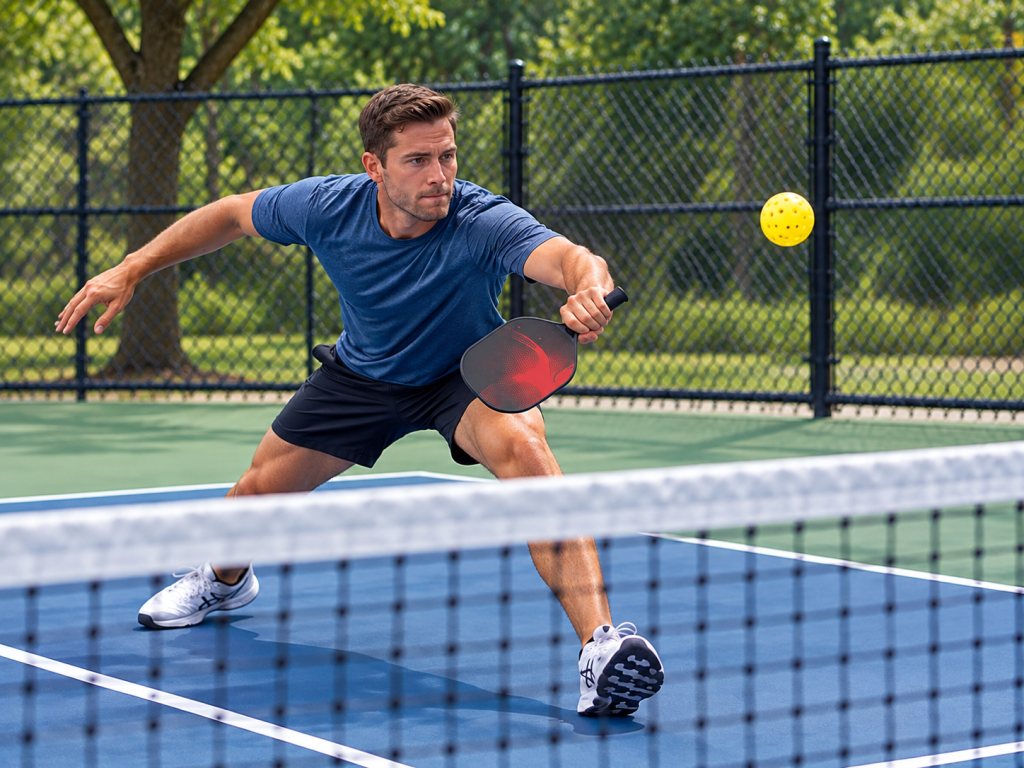
Volley Fundamentals
A volley is a shot you hit before the ball bounces. Volleys are especially common when you are positioned near the kitchen line, where the distance between you and your opponent is shorter and the ball often comes back quickly.
Good volley technique is not about taking a big swing or hitting as hard as possible. For beginners, the goal is much simpler: keep the paddle ready, make compact movements, contact the ball in front of your body, and maintain enough control to prepare for the next shot.
Developing a reliable pickleball volley starts with learning to do less. A short, controlled movement is usually more effective than a large swing.
What Makes a Volley Different?
The defining feature of a volley is that you strike the ball while it is still in the air.
This makes a volley different from a groundstroke, which is played after the ball bounces. With a groundstroke, you normally have more time and space to prepare your paddle and make a longer swing. During a volley exchange near the net, you may have very little time between your opponent hitting the ball and the ball reaching you.
That shorter reaction time changes the way you should prepare.
Instead of taking the paddle far behind your body and swinging through the ball, you generally want the paddle already positioned in front of you. Your movement toward the ball can then remain short and controlled.
Think of a volley as meeting and redirecting the ball rather than trying to create a powerful swing.
Volleys And The Non-Volley Zone
Volleys are closely connected to the non-volley zone, commonly called the kitchen.
You cannot volley while touching the non-volley zone or its boundary line. Your momentum after making a volley also cannot carry you into the zone. Because of this rule, players commonly position themselves just behind the kitchen line when preparing for volleys.
Being close to the line puts you near the net while still allowing you to volley legally, provided you maintain control of your position.
This makes balance particularly important. A technically good volley can still result in a fault if you lose your balance and step into the kitchen because of the volleying motion.
Give yourself enough room behind the line to remain stable rather than crowding it so closely that a small forward movement creates a fault.
Start With A Balanced Ready Position
A dependable volley begins before the ball reaches you.
Stand in a balanced athletic position with your knees slightly bent and your weight comfortably supported by both feet. Keep your upper body relaxed rather than stiff or upright.
Your feet should allow you to make small adjustments in either direction. Avoid planting your feet heavily on the court because this makes it harder to respond when the ball changes direction.
Your paddle should be in front of your body where you can move it quickly toward either side.
This ready position reduces the distance the paddle must travel. If the paddle is hanging beside your leg or resting behind your body, you lose valuable time bringing it back into position.
Near the net, that small delay can make a major difference.
Keep The Paddle In Front
One of the simplest habits you can develop for a better pickleball volley is keeping your paddle in front of you.
The paddle should be held at a comfortable height where it can respond quickly to balls around your waist and upper body. You do not need to hold it rigidly in one exact position. The goal is to establish a neutral starting point from which you can react efficiently.
Imagine that the paddle is protecting the space in front of your body.
When the ball comes toward you, the paddle should not have to travel from somewhere behind you. It should already be close to the path of the incoming ball.
After each volley, return the paddle toward this ready position. Do not leave it extended to one side while watching where your shot goes.
The rally may continue immediately.
Use Relaxed Grip Pressure
Holding the paddle securely does not mean squeezing the handle as tightly as possible.
Excessive grip pressure can create tension through your hand, wrist, forearm, and shoulder. That tension makes it harder to control the paddle and can cause the ball to rebound more aggressively than intended.
Use enough pressure to keep the paddle stable without making your hand rigid.
A relaxed grip also makes it easier to respond to different incoming speeds. You still need enough stability to prevent the paddle from twisting unexpectedly, but you do not need to strangle the handle.
Pay attention to your grip between shots. Beginners sometimes start with a comfortable grip and then gradually squeeze harder as a rally becomes faster.
If you notice your arm becoming tense, reduce the unnecessary pressure while maintaining control of the paddle.
Prepare The Paddle Early
Because volleys happen quickly, early preparation matters.
Watch your opponent and the ball as the shot develops. As soon as you recognize where the ball is traveling, begin positioning the paddle to meet it.
Early preparation does not mean making a large backswing.
In fact, the opposite is usually more useful. Move the paddle into the expected contact area while keeping it relatively close to the front of your body.
This gives you more time to make a controlled contact.
Waiting until the ball is almost beside you often leads to rushed movements, late contact, and excessive swinging. The earlier you recognize the incoming ball, the simpler your volley can become.
Keep The Stroke Compact
A volley usually requires much less paddle movement than a groundstroke.
Avoid pulling the paddle far behind your body. A large backswing takes time, makes timing more difficult, and can produce more power than you need.
Instead, use a compact forward movement.
The paddle begins in front, moves a short distance toward the ball, makes contact, and continues with a short follow-through. Your shoulder and forearm work together to guide the paddle while your wrist remains controlled.
The exact amount of movement will vary depending on the incoming ball. A slower ball may require a little more forward movement, while a faster ball may require very little.
The basic principle remains the same: use only as much movement as the shot requires.
Contact The Ball In Front
Whenever possible, make contact in front of your body.
Contacting the ball in front gives you a stronger and more controlled position. You can see the ball more clearly, maintain a stable paddle face, and direct the shot without having to make awkward last-second movements.
If you allow the ball to travel too far beside or behind you, controlling the paddle becomes more difficult.
Your ideal contact point will change slightly depending on where the ball arrives. You do not need to force every volley into exactly the same location. Instead, focus on keeping the contact comfortably in front rather than letting the ball crowd your body.
If the ball is slightly outside your comfortable reach, move your feet when possible instead of stretching your arm excessively.
Good positioning creates better contact.
Maintain A Stable Paddle Face
The paddle face is the flat hitting surface of your paddle. Its angle at contact has a major influence on where the ball travels.
For a controlled volley, keep the paddle face stable as you meet the ball.
Excessive wrist movement can cause the paddle face to change angle at the last moment. If the face opens too much, the ball may pop high into the air. If it closes too much, the ball may travel downward into the net.
A quieter wrist makes the paddle easier to control.
This does not mean your entire arm should become stiff. Your hand, forearm, and shoulder can remain relaxed while the paddle face stays controlled through contact.
Watch what happens to the ball after it leaves your paddle. Its flight provides useful feedback about your paddle angle.
Control The Ball Instead Of Swinging Hard
A common beginner mistake is treating every volley as an opportunity to hit harder.
Often, the incoming ball already has enough pace.
If you add a large, forceful swing to a fast incoming ball, controlling the result becomes much more difficult. The ball may travel long, pop up, or leave the paddle at an unintended angle.
Focus first on clean contact.
Let the paddle meet the ball with a controlled forward movement. Your goal is to send a playable shot back over the net while remaining balanced and ready.
This approach is particularly important during quick exchanges. When the ball repeatedly travels back and forth near the net, compact movements give you more time to recover between contacts.
Control allows you to stay in the rally.
Use A Short Follow-Through
After contact, allow the paddle to continue naturally toward your intended direction, but keep the follow-through relatively short.
A large follow-through can pull your paddle away from the ready position and may also affect your balance.
Once the volley is complete, bring the paddle back in front of your body.
This recovery should become part of the stroke itself:
Prepare, contact, finish, recover.
If another ball comes back immediately, you want to be ready rather than still finishing the previous shot.
Stay Balanced Through Contact
Your upper-body technique works best when your lower body provides a stable base.
Avoid leaning dramatically toward the ball or throwing your body forward as you volley. Keep your weight controlled and your feet underneath you as much as possible.
If the ball requires a small movement, use your feet to adjust your position.
Small adjustment steps can help you create comfortable space between your body and the ball. They also allow you to maintain a stronger contact position instead of reaching with your arm.
Balance is particularly important near the kitchen because uncontrolled forward momentum can create a non-volley zone fault.
Make the shot from a position you can control, and finish in a position from which you can recover.
Handling Volleys At Different Heights
Not every volley arrives at the same height.
Some balls may reach you around the waist. Others may arrive around the chest or shoulders, while lower balls may require you to bend more through your knees.
Adjust your paddle to the height of the incoming ball rather than trying to force every ball into the same contact position.
For a comfortable waist- or chest-high ball, you can usually maintain your normal athletic posture and make a compact contact in front.
For a lower ball, bend your knees and lower your body rather than simply dropping the paddle while remaining upright. Keeping your body balanced gives you better control of the paddle face.
Whatever the height, avoid automatically trying to hit the ball hard. The quality of the incoming ball should influence how you respond.
Move Your Feet Instead Of Reaching
Your arm has a limited comfortable hitting range.
When a ball travels slightly away from you, your first instinct may be to stretch the paddle as far as possible. Excessive reaching can pull you off balance and reduce your control.
Use small foot movements when you have time.
A short lateral step can place your body behind the shot and give you a much more comfortable contact point. After the volley, recover toward a balanced position.
You will not always have enough time to move perfectly during a fast exchange, but developing the habit of using your feet will reduce unnecessary reaching.
The goal is not to make large movements. Near the kitchen line, small adjustments are often enough.
Common Beginner Volley Mistakes
Several mistakes tend to appear when players first learn to volley.
One of the most common is taking too much backswing. When the paddle moves far behind the body, the stroke becomes slower and harder to time. Start with the paddle in front and keep the movement compact.
Another mistake is gripping the paddle too tightly. Excessive tension reduces touch and makes controlled contact more difficult. Maintain a secure but relaxed grip.
Some beginners also swing at every incoming ball regardless of its speed. Remember that a faster ball may require less movement, not more.
Late contact is another frequent problem. Prepare early and try to meet the ball in front rather than allowing it to travel beside your body.
Finally, watch your balance. Reaching, lunging, or leaning excessively can reduce control and may cause you to step into the kitchen after a volley.
Correct one problem at a time rather than changing several parts of your technique at once.
A Simple Partner Volley Drill
A basic partner drill can help you develop the compact movement required for volleys.
Stand across the net from a partner at a comfortable distance. Begin with slow, controlled exchanges rather than trying to create a fast rally.
Keep your paddle in front and attempt to return each ball with a short movement. Concentrate on making contact in front of your body and returning the paddle to the ready position after every shot.
Count how many controlled exchanges you can complete without either player taking a large swing or losing balance.
As your control improves, your partner can gradually send balls to slightly different locations so you have to make small foot adjustments.
The purpose of the drill is not to defeat your partner. It is to develop repeatable contact, paddle readiness, and recovery.
Building A Reliable Pickleball Volley
A dependable pickleball volley is built around efficiency.
Keep your body balanced, your paddle in front, and your grip relaxed. Prepare early and use a compact movement instead of a full swing. Meet the ball in front with a stable paddle face, finish with a short follow-through, and recover immediately.
These habits allow you to react more effectively when the ball comes back quickly.
As the pace increases, resist the temptation to make your movements bigger. Faster exchanges usually reward simpler preparation and shorter strokes.
Key Takeaways
- A volley is a shot hit before the ball bounces, and it is commonly used during play near the kitchen line.
- Start from a balanced athletic stance with the paddle held in front at a comfortable ready height.
- Use a relaxed grip, compact paddle movement, minimal backswing, and a stable paddle face.
- Contact the ball in front of your body and control it rather than automatically trying to hit harder.
- Keep the follow-through short and return the paddle to the ready position immediately after each volley.
- Use small foot adjustments when necessary instead of relying on excessive reaching or lunging.
- Maintain balance throughout the shot, especially near the kitchen line where uncontrolled momentum can cause a non-volley zone fault.
- Practice slow, controlled partner volleys to develop clean contact, quick recovery, and repeatable technique.