
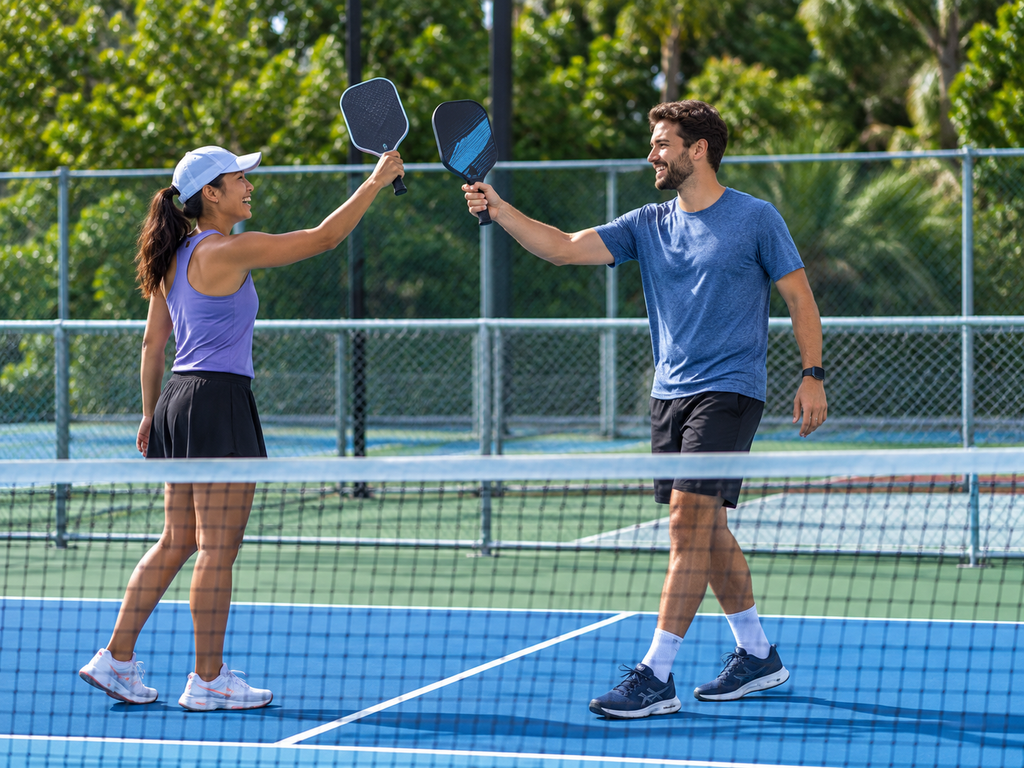
Your Path to the Next Skill Level
Finishing a beginner pickleball course does not mean you have finished learning the fundamentals. It means you now have enough knowledge and experience to start identifying what works well in your game, what still breaks down, and what deserves more attention in practice.
The best way to improve pickleball skills after the beginner level is to build on the techniques you already know rather than constantly searching for new shots. A more reliable serve, a deeper return, better positioning, or five controlled dinks in a row can make a bigger difference than learning an advanced technique before your basic game is dependable.
Your next step is to evaluate your current game, choose a few specific priorities, and create a realistic plan for continued practice and play.
Review What You Can Already Do
Start by looking at the skills you have developed throughout the course. You have worked with serving, returning, forehand and backhand groundstrokes, dinking, volleys, movement, positioning, rules, scoring, strategy, communication, and court etiquette.
You do not need to perform every skill perfectly. Instead, ask whether you can perform each skill reliably enough to use it during a recreational game.
A useful self-evaluation is based on what normally happens on the court rather than what happens during your best attempts. If you can occasionally hit an excellent serve but regularly miss several serves during games, serving is still an area that needs attention. If you can maintain a dink rally during practice but lose control when the pace changes, your dinking needs greater consistency.
Look for patterns. Repeated patterns tell you much more about your game than one unusually good or bad rally.
Identify Your Strengths
Recognizing what you already do well gives you a starting point for future development.
Perhaps your serve regularly lands in the correct service court. You may be comfortable returning slower and medium-paced serves. Your forehand might feel more natural than your backhand. You may move well with a doubles partner or remain composed during kitchen exchanges.
A strength does not need to be an advanced skill. At the beginner level, reliable fundamentals are valuable strengths.
For example, consistently getting your serve in play gives you a dependable way to start rallies. Maintaining good balance at the kitchen line makes it easier to handle volleys and dinks. Communicating clearly with a partner can prevent confusion even when your technique is still developing.
Keep using these strengths while working on weaker areas. Your goal is not to replace what already works but to make your overall game more balanced.
Find the Skills That Need More Work
The next step is to identify the areas that regularly cause problems.
Evaluate your serve first. Can you place it legally and consistently into the correct service court? Does it frequently land short, hit the net, or travel long? Can you serve with reasonable depth without losing control?
Then look at your return of serve. Are you giving yourself enough space to let the serve bounce? Can you return the ball with useful height and depth? Are you able to move forward under control after returning?
Consider both your forehand and backhand. You may notice that one side produces clean, controlled shots while the other leads to late contact, excessive reaching, or inconsistent paddle control.
At the kitchen, examine your dinks and volleys separately. Can you keep a dink soft enough to land in the opponent’s non-volley zone? Can you maintain several controlled dinks before making an error? On volleys, are you keeping the paddle in front and using compact movement, or are you taking large swings that make the ball difficult to control?
Movement deserves the same attention as hitting technique. Notice whether you reach for balls instead of moving your feet, lose balance after shots, retreat unnecessarily, or struggle to stop under control near the kitchen line.
These observations help you decide what actually needs practice.
Look Beyond Individual Shots
Improvement is not only about hitting the ball better.
Court positioning can have a major effect on how difficult each shot feels. A technically sound forehand becomes much harder when you are standing in the wrong place or contacting the ball while off balance.
Notice where you tend to position yourself during rallies. Do you remain at the baseline longer than necessary? Do you become stuck in the transition area? Once you reach the kitchen line, do you maintain your position or drift backward without a reason?
In doubles, pay attention to your relationship with your partner. You should be aware of spacing, middle coverage, lateral movement, and whether both players are operating at a similar court depth.
Communication also deserves evaluation. Calls such as “mine,” “yours,” and “out” should be clear and early enough to help both players react. If balls through the middle regularly create confusion, communication may need as much attention as stroke technique.
Recognize Recurring Faults and Strategy Mistakes
A useful improvement plan includes the mistakes that repeatedly cost you rallies.
You may commit kitchen faults because you stand too close to the non-volley zone line. You may forget the two-bounce requirement when a rally begins. You might contact serves from an inconsistent position or occasionally lose track of the serving order.
Strategy mistakes can also become patterns.
Perhaps you try to hit difficult winners when a safer shot would keep the rally going. You may attack balls that are too low, aim too close to the sidelines, or swing harder when you are under pressure. In doubles, you might leave large spaces between you and your partner or fail to move laterally together.
Identify the pattern instead of treating every mistake as an isolated event.
If you hit several balls into the net because you are attacking from a low contact point, the solution is not simply to “hit better.” The better adjustment may be to choose a controlled shot when the ball is low.
Understanding why errors happen helps you improve pickleball skills more efficiently.
Set Specific Short-Term Goals
Once you have identified your priorities, turn them into simple goals.
A vague goal such as “get better at pickleball” does not tell you what to practice. A specific goal gives your practice direction.
For serving, you might work toward placing eight out of ten serves legally into a large target area. For returns, you might aim to send most returns beyond the middle portion of the opponent’s court while staying balanced.
A dinking goal could be maintaining ten cooperative shots with a partner. A groundstroke goal might be completing a controlled rally without trying to increase pace. A positioning goal could focus on moving forward after the return and arriving at the kitchen line under control.
Choose only a small number of priorities at one time. Trying to fix your serve, return, backhand, dinks, volleys, footwork, positioning, and strategy during the same session makes it difficult to concentrate on any of them properly.
Build Longer-Term Improvement Goals
Short-term goals address specific weaknesses. Longer-term goals describe the type of player you want to become.
You might want to become more consistent during longer rallies, develop dependable shot placement, improve your transition from the baseline to the kitchen, or become more comfortable handling faster exchanges near the net.
One useful long-term goal is improving depth and placement without relying on excessive power. A deeper serve or return can be effective even when it is not hit hard. Controlled placement can also make your shots more useful without requiring difficult angles.
Another valuable goal is becoming comfortable throughout the entire court. Some beginners prefer staying near the baseline because longer groundstrokes feel familiar. Others hurry toward the kitchen without being balanced when they arrive.
Improved players learn to move through these different areas of the court with greater control.
Improve Rally Consistency
Rally consistency is one of the clearest signs that your fundamentals are becoming more dependable.
Count how many playable shots you can make in a row during cooperative practice. You can do this with groundstrokes, dinks, or volleys.
The purpose is not to create a record for its own sake. Counting makes improvement easier to observe.
If you currently average four or five controlled dinks before an error, try building toward eight. If you can maintain ten groundstrokes with a partner at a comfortable pace, gradually increase the goal while keeping the same controlled technique.
Do not increase speed simply because the rally becomes easier. First make your movement, contact, placement, and recovery repeatable. Pace can increase naturally as your control improves.
Develop Better Transition Play
Moving from the back of the court toward the kitchen is an important part of becoming a more complete player.
Beginners sometimes treat this movement as a race. They hit the ball and immediately charge toward the net, arriving off balance when the opponent makes contact.
Controlled transition is more useful.
Move forward when the situation allows it, stay aware of the opponent and the ball, and be prepared to stop in a balanced position before playing the next shot. You may need to advance in stages rather than reaching the kitchen line immediately.
In doubles, transition with awareness of your partner. Large differences in court depth can create open areas for opponents.
Improving this part of your game connects your baseline skills with your kitchen play.
Become More Comfortable at the Kitchen
Comfort near the kitchen comes from good positioning, paddle readiness, controlled movement, and repeated exposure to close-range rallies.
Spend time practicing soft dinks from both the forehand and backhand sides. Work on keeping the paddle in front during volleys. Practice small lateral movements while maintaining your position just behind the non-volley zone line.
Pay attention to balance after every shot.
When you become stretched or pulled wide, recover instead of remaining out of position. When an opponent hits a faster ball, use a compact block rather than automatically taking a large swing.
Kitchen confidence is not measured by how aggressively you attack. It is reflected in your ability to remain balanced, control the ball, and make appropriate decisions during faster or softer exchanges.
Play With Different People
Practice provides repetition, but playing with different partners and opponents teaches you how to apply your skills in changing situations.
Different players create different challenges. One opponent may hit hard. Another may rely on soft shots. Some players place the ball well without using much pace. Others may keep rallies going until someone makes an error.
Different doubles partners also require adjustments. You will need to communicate, maintain spacing, and learn how each partner moves around the court.
Playing with a variety of people helps prevent your game from becoming dependent on one familiar practice partner or one predictable style of play.
Use Recreational Play as Practice
A recreational game can be more than a test of whether you win.
Choose one specific skill to observe during a game. You might focus on getting your returns deep, maintaining kitchen position, communicating earlier with your partner, or reducing unnecessary power.
After the game, think about whether that skill held up under normal rally pressure.
This gives you useful information for your next practice session.
Winning a game can feel satisfying, but it does not always mean you played well. Losing does not automatically mean your technique was poor. Look at the decisions and repeated patterns inside the game.
Learn From Clinics, Lessons, and Experienced Players
Organized clinics or individual instruction can provide useful feedback when you want help correcting a recurring problem or developing more efficient technique.
Experienced players can also be valuable to watch.
Instead of watching only the ball, observe how players prepare before contact. Notice where they stand, how little paddle movement they may use during volleys, how they move with their partner, and how quickly they recover after shots.
Pay attention to decision-making as well. Experienced players often appear less rushed because they recognize which balls should be attacked, which should remain soft, and where safer target areas are located.
The purpose of observation is to find useful habits, not to copy every technique you see.
Know When You Are Ready for Intermediate Instruction
Moving beyond beginner-level instruction should be based on the reliability of your fundamentals rather than how long you have been playing.
You are developing toward the next level when you can serve and return consistently, sustain basic groundstroke and dink rallies, control simple volleys, move around the court with reasonable balance, understand positioning, follow the rules and scoring system, and make intentional shot choices during games.
You do not need perfect technique.
However, intermediate instruction becomes more useful when basic skills are dependable enough that you can build on them rather than repeatedly rebuilding them.
If fundamental errors still dominate your game, additional practice on those fundamentals may give you more value than adding more complicated techniques.
Track Your Progress Over Time
Improvement can be difficult to notice when you play regularly because changes often happen gradually.
Keep simple records of measurable goals. You might track successful serves out of ten attempts, consecutive cooperative dinks, controlled groundstroke rallies, or how often you reach the kitchen line in balance after returning.
You can also note recurring problems after games.
A short note such as “backhand returns were late” or “kept backing away from the kitchen line” gives you something specific to work on next time.
Review these observations occasionally. A weakness that appeared every week may eventually stop appearing. That is evidence of progress and a signal that your practice priorities can change.
Build a Sustainable Pickleball Routine
The final part of your plan is consistency over time.
Regular practice does not need to mean long sessions. Focused work on one or two skills can be productive when the repetitions are controlled and purposeful.
Balance drills with actual games. Drills allow you to repeat specific movements. Games require you to decide when and how to use those movements.
Continue giving fundamentals a place in your routine even as you become more experienced. Reliable serves, returns, footwork, positioning, dinks, volleys, and communication remain important at every stage.
That approach gives you a practical way to improve pickleball skills without rushing toward techniques that your current game does not yet require.
Your next level is built by making the skills you already know more reliable, more controlled, and easier to use during real play.
Key Takeaways
- Evaluate your normal performance, not just your best shots, to identify genuine strengths and weaknesses.
- Choose a small number of specific skills to improve rather than trying to change your entire game at once.
- Prioritize consistency, placement, movement, positioning, and decision-making before adding unnecessary complexity.
- Use drills, recreational games, different partners, clinics, and observation of experienced players as different ways to develop your game.
- Track simple results over time so you can recognize progress and adjust your practice priorities.
- Move toward intermediate instruction when your fundamental skills are reliable enough to provide a stable foundation for further development.