

Golf can look complicated when you first encounter it. There are different clubs, unfamiliar terms, large playing areas, scoring conventions, and many types of shots. Underneath all of that, however, the basic idea of the game is straightforward.
Golf is a precision sport in which a player uses a club to strike a ball and move it from the starting point of a hole to its finishing point. The goal is to complete each hole – and ultimately the entire round – using as few strokes as possible.
Understanding that basic purpose gives you a foundation for everything else you will learn about golf.
What Is Golf?
Golf is primarily an individual precision sport. Instead of relying on teammates to pass, defend, or score, the golfer is responsible for moving their own ball around the course and recording the result.
A stroke is the basic playing action in golf: the player makes a swing with a club intending to strike the ball. We will cover exactly what counts as a stroke in the next lesson, but for now, think of each stroke as another attempt used to move the ball toward the completion of the hole.
The basic pattern is simple:
Start the hole → strike the ball → continue playing the ball → complete the hole.
That process is repeated across the holes that make up the round.
Golf is therefore not simply about hitting a ball a long distance. A golfer must repeatedly control where the ball goes and eventually complete each hole while using as few strokes as possible.
Did you know?
Golf is Over 500 Years Old! The game as we know it today originated in Scotland in the 15th century. It became so popular that King James II actually banned it in 1457 because he thought it was distracting soldiers from practicing archery!
The Objective of Golf
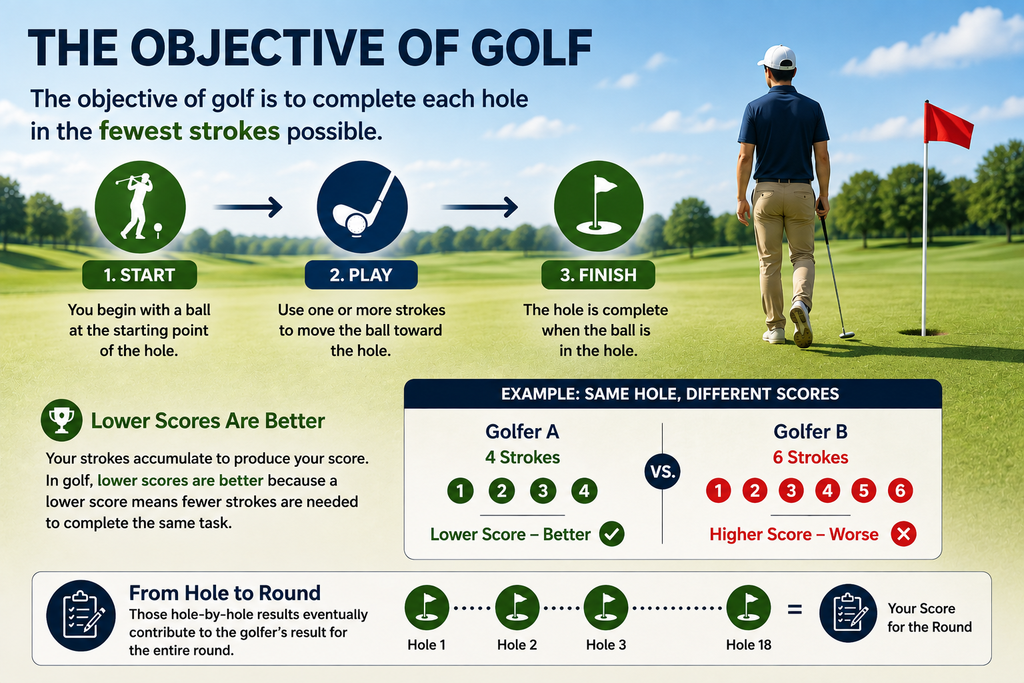
The objective of golf is to complete each hole in the fewest strokes possible.
Every time you play a hole, you begin with a ball at its designated starting point. You then use one or more strokes to move that ball until the hole has been completed.
Your strokes accumulate to produce your score. In golf, lower scores are better because a lower score means you required fewer strokes to complete the same task.
For example, imagine two golfers complete the same hole. One takes four strokes and the other takes six. All else being equal, the golfer who took four strokes has the better score for that hole.
Those hole-by-hole results eventually contribute to the golfer’s result for the entire round.
That is enough scoring knowledge for now. Golf has its own scoring system and terminology, and How Golf Scoring Works covers those concepts fully in the next lesson.
How Golf Is Played
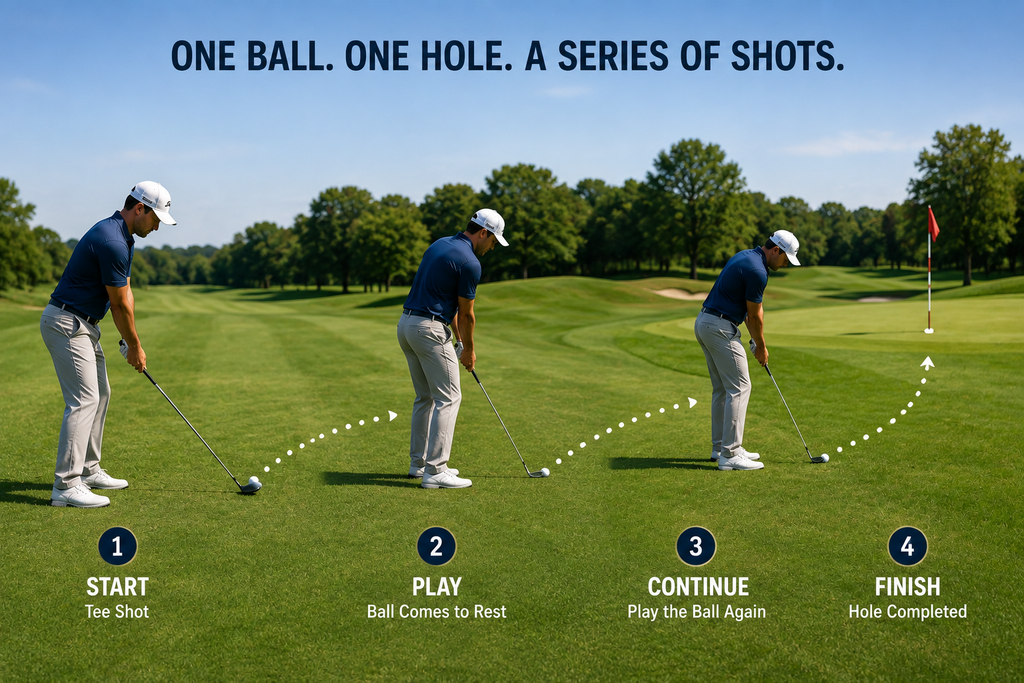
At its most basic level, golf involves three things: a golfer, a golf ball, and clubs used to strike that ball.
Each hole provides a separate playing challenge with a defined beginning and end. The golfer starts the hole, strikes the ball, finds where it has come to rest, and plays it again. This continues until the hole is completed.
The important concept for a new golfer is continuity: you are not starting a completely new attempt after every shot. You are progressing through the hole with the ball you are playing.
After completing one hole, you move to the next. A collection of holes makes up a round of golf.
This creates an unusual sporting challenge. One stroke affects the situation you face on the next stroke. A well-controlled shot can leave a more manageable next attempt, while an inaccurate shot can make the next one more difficult.
You do not need to understand the specific areas of a golf course yet. Those are introduced separately in Understanding the Parts of a Golf Course.
Golf as an Individual and Competitive Sport

Golf can be played in several different ways, which is one reason people can participate in it for very different purposes.
At the simplest level, you can play against your own score. Many recreational golfers are primarily interested in improving their own performance. They may play with friends while still measuring success by how well they personally complete the course.
Golf can also be played directly against other golfers. In competition, players or sides compare their performances according to the format being used.
This means golf can be both personal and competitive at the same time. Two friends can enjoy a recreational round together while each golfer is also trying to improve their own result.
At higher competitive levels, the same basic objective remains. The golfers are far more skilled, but they are still trying to complete the required golf challenge more effectively than their competitors.
The Main Formats of Golf
There are many ways to organize a golf competition, but two formats are fundamental to understanding the sport: stroke play and match play.
Stroke Play

In stroke play, the golfer’s strokes are accumulated across the round, and the overall result determines the outcome.
This makes the entire round important. A golfer’s performance is not viewed as a collection of completely separate contests; the strokes contribute to an overall result.
Detailed score calculation belongs in the next lesson, so for now the key idea is:
Stroke play compares overall scoring performance.
Match Play
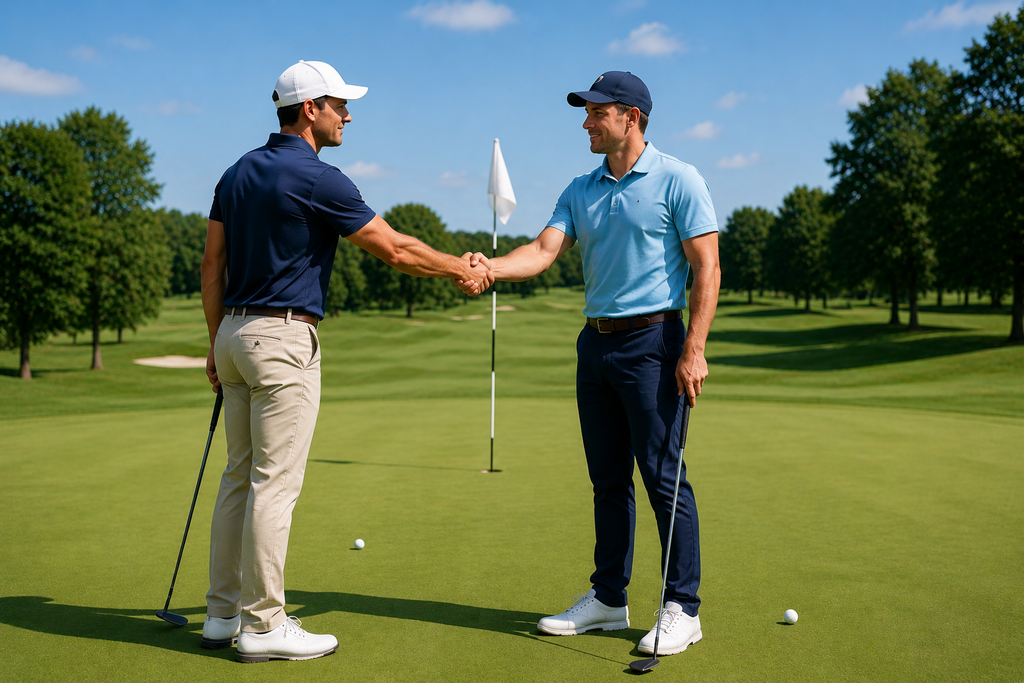
Match play organizes the competition differently. Instead of the primary comparison being the golfers’ total strokes for the entire round, players or sides compete hole by hole.
One player or side can win an individual hole, and the match develops according to those hole-by-hole results.
The key distinction for a beginner is therefore:
Stroke play focuses on the overall scoring result; match play focuses on winning individual holes.
There are additional details and procedures associated with these formats, but they are not necessary for understanding the basic nature of golf.
What Skills Does Golf Require?
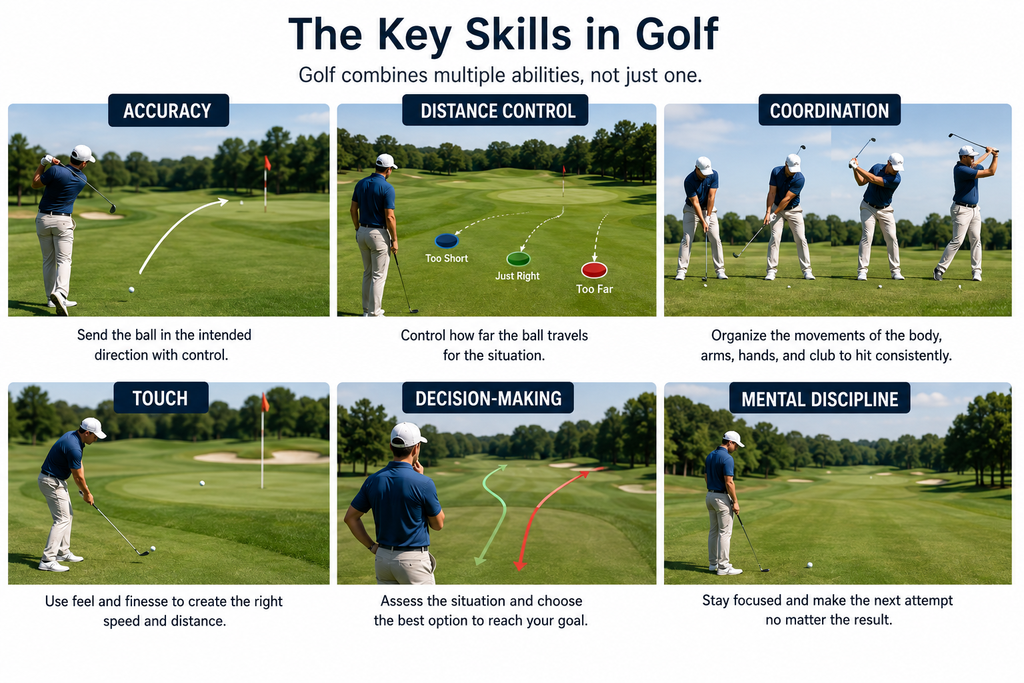
Golf combines several skills rather than rewarding only one physical ability.
Accuracy is the ability to send the ball in an intended direction with useful control. Because golf requires repeated shots toward specific objectives, distance without sufficient accuracy has limited value.
Distance control means controlling how far the ball travels. Golf is not simply a contest to hit every shot as far as possible. A golfer frequently needs the ball to travel an appropriate distance for the situation.
Coordination allows the golfer to organize the movements required to deliver the club to the ball consistently. The golf swing eventually involves coordinated movement of the body, arms, hands, and club, but you will learn those mechanics later in the course.
Touch describes the ability to produce controlled differences in speed and distance, particularly when a shot requires more finesse than power. Golfers must learn that not every situation calls for the same amount of force.
Decision-making matters because golfers repeatedly have choices about what they are trying to accomplish. Physical execution is important, but golf also requires players to assess situations and make sensible decisions.
Mental discipline helps a golfer stay focused and make the next attempt after both good and poor results. A round contains many individual shots, so one mistake does not end the game.
These abilities develop at different rates. A beginner does not need all of them to be highly developed before playing golf.
Why Golf Is Different from Many Other Sports
One of golf’s defining characteristics is that it does not take place on a single standardized playing field.
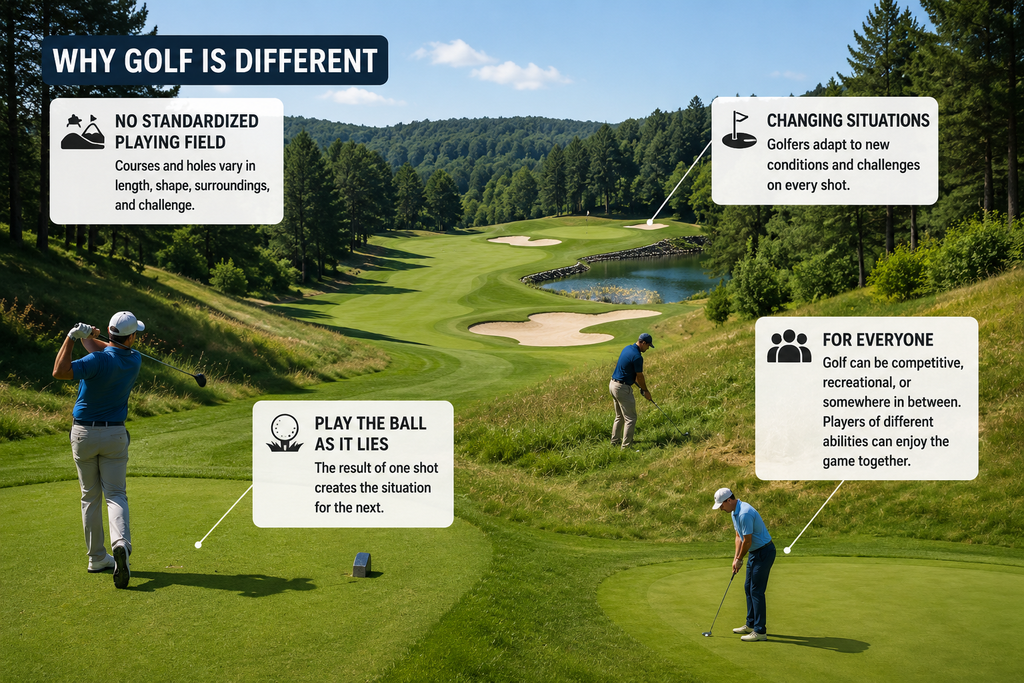
A basketball court or soccer field has standardized dimensions within the rules of the sport. Golf courses, by contrast, can differ substantially from one another. Individual holes also present different lengths, shapes, surroundings, and challenges.
As a result, golfers do not simply repeat the same task in the same environment. They must adapt to changing situations throughout a round.
Golf also operates around an important basic principle: the player generally plays the ball from where it has come to rest. That means the outcome of one stroke helps create the circumstances for the next. There are situations in which golf’s rules allow or require a different procedure, but those rules belong later in the course.
Another distinctive feature is the range of ways people can participate. Golf can be a serious competitive sport, a recreational activity, or something in between.
Players of different abilities can also share a round. They may produce very different scores and hit the ball very different distances, yet still participate in the same game together. That makes golf unusual in the way recreational players of varying experience can share the playing environment while pursuing their own performance.
Did you know?
The Origin of the Word: Contrary to a popular urban legend, the word “GOLF” does not stand for “Gentlemen Only, Ladies Forbidden.” It actually derives from the old Dutch word “kolf” or “kolve,” meaning club.
Is Golf Difficult for Beginners?
Golf has a noticeable learning curve because the basic objective is simple but performing it consistently is not.
A beginner is learning to control a relatively small ball with a club while managing direction, distance, and contact. Eventually, the golfer must also understand the course, scoring, equipment, rules, terminology, and different playing situations.
That can make the sport seem overwhelming when everything is encountered at once.
The solution is not to try to master all of golf immediately.
Consistency develops gradually because golf requires both knowledge and physical skill. You first need to understand what you are trying to do. Then you can learn the individual fundamentals in a sensible sequence and gradually combine them.
Early inconsistency is therefore not evidence that you cannot learn golf. It reflects the number of separate skills that eventually have to work together.
For a beginner, the useful goal is progressive competence rather than immediate mastery: understand one part of the game, practice it, and then build the next skill on top of it.
Find the right golf gear for your game.

Shop Golf Gear
Home Golf Gear for Every Type of Player Find golf clubs, sets, and accessories based on how you play. Explore forgiving equipment for an easier game, balanced options as your skills improve,…
What You Will Learn as a Beginner
Now that you understand the basic concept of golf, the rest of the SPS Beginner Golf Course can build on that foundation.
You will learn how golf scoring works, how a golf course is organized, and the language golfers use. You will also learn what happens during an actual round so the experience becomes familiar before you play.
From there, the course moves into essential rules and etiquette, equipment, and preparation. Later modules develop your setup, golf swing, individual shots, short game, practice habits, troubleshooting skills, and eventually the knowledge needed to play real rounds more confidently.
Key Takeaways
- • Golf is an individual precision sport in which players use clubs to move a ball from the beginning of a hole to its completion.
- • The objective is to complete each hole and the overall round using as few strokes as possible, which is why lower scores are better.
- • Golf can be recreational or competitive, with stroke play and match play representing two fundamental competition formats.
- • Successful golf requires a combination of accuracy, distance control, coordination, touch, decision-making, and mental discipline.
- • Beginners do not need to understand or master every part of golf immediately. The game becomes more manageable when it is learned progressively.
Now that you understand what golf is and what the player is trying to accomplish, the next step is understanding how performance is measured. In Lesson 2: How Golf Scoring Works, you will learn exactly how golf scores are calculated and what the common scoring terms mean.